How Ceiling Fans and HVAC Work Better Together: A Homeowner's Guide to Staying Comfortable and Saving Energy
A ceiling fan running in an empty room does nothing but spin. A ceiling fan running in a room you're actually sitting in can let you raise your thermostat several degrees without noticing the difference. Same fan, same electricity cost — the only variable that matters is whether it's working with your HVAC system or just running alongside it.
Fans and HVAC get treated as competitors. They're not.
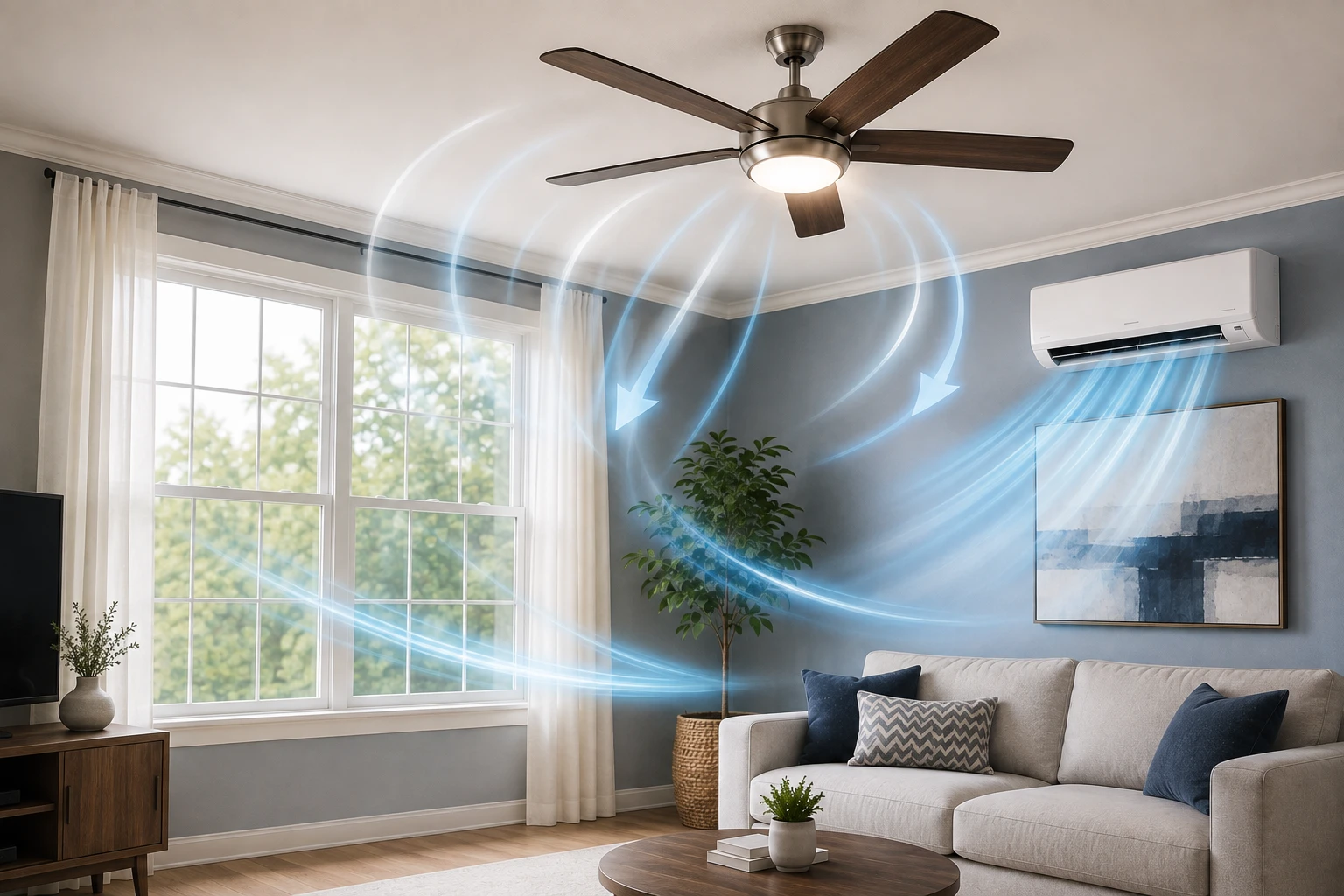
Most homeowners think of it as a choice: run the AC, or run a fan and skip the electric bill. That framing misses what a ceiling fan actually does. A fan doesn't compete with your HVAC system — it changes how much work your HVAC system has to do to keep you comfortable. Used correctly alongside a properly functioning AC or heat pump, a ceiling fan is one of the cheapest comfort upgrades in the house. Used incorrectly — left running in empty rooms, spinning the wrong direction, or asked to substitute for AC on a 105°F day — it does close to nothing, or actively works against you.
The physics: a fan cools you, not the room
This is the single most important thing to understand, because it explains almost everything else in this article. A ceiling fan does not lower the air temperature of a room. A thermometer sitting under a running fan reads the same number as a thermometer in the same room with the fan off.
What a fan does is move air across your skin. That moving air increases two things your body already uses to shed heat: convective heat loss (warm air near your skin gets continuously replaced with slightly cooler air) and evaporative cooling (moving air speeds up the evaporation of perspiration, which is one of the most effective cooling mechanisms your body has). Together, a typical ceiling fan running at a comfortable speed makes a room feel roughly 4°F cooler than the thermometer actually reads — without the air itself changing temperature at all.
That 4°F "feels-like" gap is the whole game. It's why the U.S. Department of Energy's standard efficiency guidance is to raise your thermostat setpoint a few degrees in any room where a ceiling fan is running and occupied — you stay just as comfortable, and your AC or heat pump runs less to get there.
Why this works especially well in Los Angeles's climate
Evaporative cooling — the mechanism doing a lot of the work in that "feels 4°F cooler" effect — is more effective in dry air than humid air, because sweat evaporates faster when the surrounding air isn't already saturated with moisture. Los Angeles and the San Fernando Valley run dry for most of the cooling season, which means fan-assisted comfort works noticeably better here than it does in a humid climate like Houston or Miami, where the same fan provides less relief for the same airspeed.
Combine that with LADWP and SCE's summer time-of-use rates, where afternoon and evening cooling costs the most per kWh, and the math gets more favorable: every degree you can raise your setpoint during peak hours — while staying comfortable because a fan is doing part of the work — is avoided cost at the most expensive part of the day, not just avoided runtime.
Getting fan direction right (the detail almost everyone skips)
Every ceiling fan has a small switch on the motor housing that reverses the blade direction. Most homeowners never touch it after installation, which means they're only getting the benefit half the year.
- Summer setting — counterclockwise, higher speed. Blades pull air up and push it back down in a direct downdraft, creating the direct breeze that produces the cooling effect on your skin.
- Winter setting — clockwise, low speed. Blades pull air upward instead, creating a gentle updraft that redistributes warm air pooled near the ceiling back down into the room without creating a cold breeze. This matters most in rooms with high or vaulted ceilings, where heated air stratifies and the thermostat below never quite reads what's actually happening near the ceiling.
Switching the direction twice a year takes under a minute and costs nothing — it's the highest-value five minutes of "HVAC maintenance" most homeowners never do.
Sizing and choosing a fan that actually performs
An undersized fan in a large room moves too little air to matter. An oversized fan in a small room creates an uncomfortable, noisy gale. Rough blade-span guidance by room size:
- Up to 75 sq ft (small bedroom, home office) — 29"-36" fan
- 76-144 sq ft (standard bedroom) — 36"-42" fan
- 144-225 sq ft (primary bedroom, living room) — 44"-50" fan
- 225+ sq ft (great room, open-concept living/dining) — 50"-60" fan, or two smaller fans instead of one oversized one
Two other details that affect real-world performance: mounting height (blades should sit 8-9 feet above the floor and at least 10-12 inches below the ceiling for effective airflow — a downrod is usually needed for vaulted ceilings, and a flush or "hugger" mount for standard 8-foot ceilings) and efficiency rating. ENERGY STAR-certified ceiling fans move roughly 20% more air per watt than standard models, which matters if you're running one for several hours a day through a Los Angeles summer.
Where ceiling fans fall short — and where they can work against you
- They don't scale to extreme heat. Once air temperature climbs into the high 90s and above, moving that air across your skin stops providing net cooling and can start adding heat instead — which is a genuine safety issue during a heat advisory, not just a comfort one. Fans are a complement to AC on hot days, never a substitute on the hottest ones.
- Running one in an empty room is pure waste. Since the entire benefit depends on a person standing in the airflow, a fan spinning in a room nobody's in provides zero comfort benefit for its electricity cost. Treat the switch like a light switch.
- They can confuse a poorly placed smart thermostat. A thermostat mounted where a fan's airflow hits it directly can read artificially cool air and under-run your system, leaving other rooms warmer than the thermostat thinks. If you've paired a smart thermostat with new ceiling fans, it's worth confirming the thermostat isn't in the direct airflow path.
- They can't fix an underlying HVAC problem. If a room runs hot no matter what you do with the fan, the more likely cause is airflow, insulation, or duct issues specific to that room — see our piece on why one room runs hotter than the rest of the house for the actual causes and fixes.
Pairing fans with the specific system you have
Central AC or heat pump
Run fans in the rooms people are actually occupying and raise the thermostat 3-4°F to match. This works best in rooms that already run a little warm — often the ones farthest from the air handler or at the end of a long duct run — where a fan can close the comfort gap without an airflow or duct fix.
Zoned systems
A zoning system already lets different parts of the house run at different setpoints. Adding fans to the rooms in active use lets you push each zone's setpoint a little further without losing comfort — the two strategies stack rather than compete.
Ductless mini-splits
This is where the pairing works best, because a ductless mini-split already gives you independent, room-by-room control. Add a ceiling fan to a room with its own mini-split head, and you can run that specific zone a few degrees warmer than you'd otherwise be comfortable with — compounding the efficiency both systems already offer, without touching the rest of the house.
Smart HVAC systems
Some smart HVAC setups and connected ceiling fans can sync automatically — the thermostat nudges its setpoint up slightly when it detects a paired fan is running and a room is occupied. It's a genuinely useful automation if you already have both, though it's not something to buy a smart thermostat for on its own.
A quick note on whole-house fans (a different thing entirely)
"Ceiling fan" and "whole-house fan" get confused constantly, and they're not the same product. A whole-house fan is a large attic-mounted exhaust fan that pulls cool outdoor evening air through open windows and vents it through the attic, rapidly cooling the whole house on nights when the outdoor temperature drops well below the indoor temperature — common in LA's coastal-influenced evenings. It's a separate system from a ceiling fan and works on a completely different principle (bulk air exchange, not skin-level cooling), and installing one is an HVAC-adjacent project worth a separate conversation, not something this article covers in depth.
A practical setup checklist
- Confirm your fan spins counterclockwise in summer, clockwise in winter — check the switch on the motor housing each season
- Turn fans off in any room you're not actively using
- Raise your thermostat 3-4°F in rooms where a fan is running and occupied
- Choose fan size by room square footage, not by what looked good in the showroom
- Keep smart thermostats out of a fan's direct airflow path
- Never rely on fans alone during a heat advisory — check on elderly neighbors and family members who may not have working AC
When it's time to call an HVAC pro instead of just adding fans
Fans are a genuinely useful tool, but they're sometimes used to paper over a problem that needs an actual fix. If you're running fans in every room, keeping the thermostat low anyway, and still paying high summer bills, that's usually a sign of something else — an aging or undersized system, leaky ductwork, or poor insulation — not a sign you need more fans. A tune-up or a broader efficiency assessment will tell you which one it actually is.
Bottom line
A ceiling fan is not a competitor to your AC or heat pump — it's a force multiplier for it, when it's running in the room you're actually in, spinning the correct direction for the season, and paired with a thermostat setpoint that reflects the comfort it's providing. Get those three things right and it's one of the cheapest, most effective comfort upgrades available. Get them wrong and it's just background noise on your electric bill.
Ceiling Fans & HVAC FAQs
Do ceiling fans actually lower my air conditioning bill?
Should I leave ceiling fans running in rooms nobody's in?
What direction should my ceiling fan spin, and does it matter?
Can ceiling fans replace air conditioning during a heat wave?
Do ceiling fans work well with ductless mini-splits or zoned systems?
Ready to get started?
Free in-home consultation with any new or replacement HVAC system, or any service / repair over $200. We answer the phone 24/7.