How Coastal Air Can Shorten the Life of Your HVAC System
A well-maintained AC or heat pump inland can run 15-20 years. The same equipment a few blocks from the Pacific can start failing in half that time — and it's rarely the compressor that goes first. It's corrosion, and it's largely preventable if you know what to look for.
The ocean view comes with a maintenance bill
Homeowners in Malibu, Pacific Palisades, Santa Monica, Topanga, Oxnard, and Ventura all ask us some version of the same question after their second AC replacement in a decade: "Why does this keep happening?" The answer almost never shows up on the utility bill or in how the system sounds. It shows up on the outdoor unit itself — white, chalky corrosion on the aluminum fins, greenish streaks around the copper joints, a cabinet that's rusting from the inside out. Coastal air doesn't make your HVAC system work harder. It makes the equipment itself fall apart faster, sometimes years before anything mechanical would have failed on its own.
Why salt air is uniquely destructive to HVAC equipment
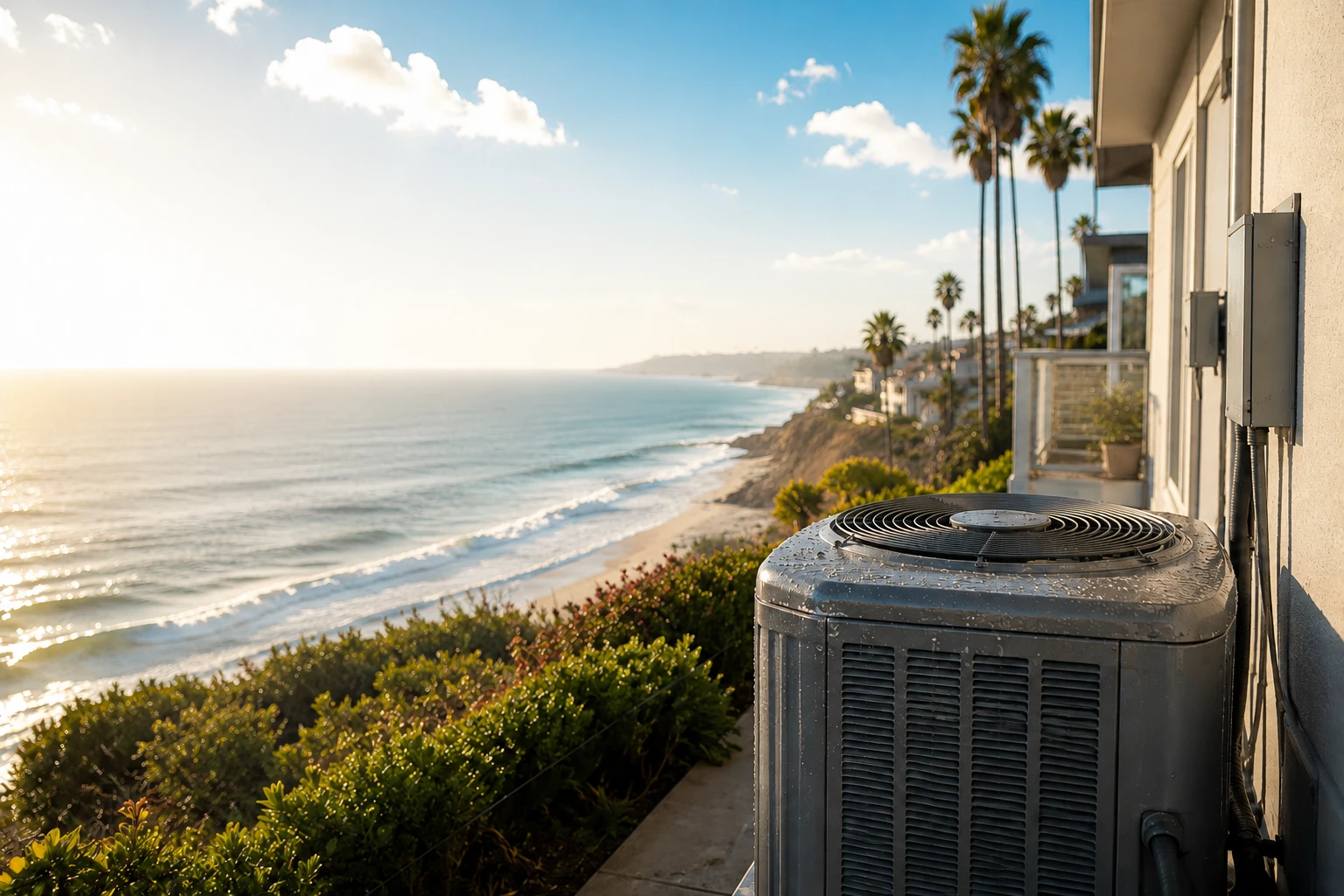
Ocean spray puts microscopic salt particles into the air, and onshore wind carries them inland, where they settle on anything exposed outdoors — including your condenser or heat pump's outdoor unit. Salt is hygroscopic, meaning it pulls moisture out of the air and holds it against whatever surface it lands on. Combined with the Southern California coast's near-constant marine layer humidity, that creates a thin, persistent film of salty moisture sitting directly on your equipment's metal surfaces for months at a time.
That film does two things conventional inland weather doesn't: it accelerates ordinary oxidation (rust), and it drives galvanic corrosion — a reaction that happens specifically when two different metals (like the aluminum fins and copper tubing in your coil) are in contact with each other in the presence of a salty electrolyte. The copper effectively corrodes the aluminum around it, pitting the fins and, eventually, opening pinhole leaks directly in the refrigerant coil — a failure mode almost unique to salt exposure that rarely happens to the same equipment even a few miles inland.
Which parts of your system take the hit first
- Outdoor coil fins — thin aluminum, the largest exposed surface area, and the first thing to show visible white corrosion
- Coil tubing and joints — where galvanic corrosion between copper and aluminum eventually causes refrigerant leaks
- Cabinet and fasteners — steel cabinets rust from the inside at seams and screw points long before it's visible from the outside
- Electrical contactors and control boards — condensed salt moisture inside the control box corrodes contacts, causing intermittent failures and no-cool calls that look electrical but trace back to corrosion
- Refrigerant line insulation — degrades faster in UV and salt air, exposing bare line to the same corrosion process
How much faster do coastal systems actually fail?
There's no single number, because it depends on distance from the water, prevailing wind direction, and how well the equipment has been maintained — but the pattern we see across the properties we service is consistent. A quality system 10+ miles inland, maintained on a normal schedule, regularly reaches 15-20 years. The same equipment installed within a mile of the coast, with no corrosion protection, commonly needs coil replacement or full system replacement at 7-12 years — sometimes sooner in homes that catch direct onshore wind, like oceanfront properties in Malibu or exposed hillside lots in the Palisades and Topanga.
The frustrating part is that the compressor — the most expensive single component — is often still fine when the system fails. It's the coil or the electrical components that go first, but once a coil has pinhole leaks from corrosion, replacing just the coil frequently costs enough that full system replacement makes more financial sense. Coastal corrosion turns what should be a repairable problem into a replacement decision.
Early warning signs worth calling about
- White, chalky, or powdery buildup on the outdoor unit's fins
- Greenish-blue streaking around copper joints or the coil itself
- Rust spots on the cabinet, especially around seams, screws, and the base pan
- Refrigerant leaks with no obvious mechanical cause — often the first sign of a corroded coil
- Breakers or contactors that fail intermittently, especially after fog or a rainy stretch
- A system that's noticeably less efficient than it was a year or two ago, with no other explanation
Any one of these is worth a professional inspection before it becomes an emergency no-cool call in the middle of a heat wave.
What actually protects a system in coastal air
The good news: none of this is inevitable. It's manageable with the right equipment and maintenance cadence, and it's far cheaper to protect a system upfront than to replace one early.
- Coastal-rated coil coatings — a factory or field-applied protective coating (often a baked-on e-coat or phenolic finish) on the coil fins blocks salt and moisture from reaching the aluminum and copper directly. This is the single highest-impact protection available and the one we recommend first for anything within a mile of the water.
- Corrosion-resistant cabinets and hardware — stainless steel fasteners and coated or composite cabinet panels instead of standard galvanized steel hold up dramatically longer.
- Routine fresh-water rinse-downs — a simple garden-hose rinse of the outdoor unit every 2-4 weeks in salt-exposed locations washes off accumulated salt before it has time to sit and corrode. This is free, takes ten minutes, and is the most commonly skipped step.
- Placement and orientation — mounting the unit away from direct onshore wind exposure, elevating it above ground-level salt spray, and positioning it so prevailing wind doesn't blow directly into the coil all extend service life.
- Sealed electrical enclosures — properly gasketed control boxes keep humid, salty air away from contactors and circuit boards, preventing the electrical failures that often get misdiagnosed as unrelated problems.
- More frequent professional maintenance — we recommend coastal properties move to a more frequent maintenance schedule than the standard twice-a-year visit, specifically to catch early corrosion before it reaches the refrigerant circuit.
What we recommend for coastal LA and Ventura County homes
For any home within about a mile of the ocean — much of Malibu, Pacific Palisades, Santa Monica, Topanga, Oxnard, and Ventura — we specify coastal-rated equipment by default: coated coils, corrosion-resistant cabinets, and stainless hardware from the start, rather than retrofitting protection after a standard system has already started corroding. For homes further inland but still within reach of onshore wind, a disciplined rinse-down schedule plus a slightly more frequent professional maintenance visit usually closes most of the gap at a fraction of the cost. We assess your specific property's exposure — distance to the water, elevation, and prevailing wind — during the free consultation, and we're upfront when a system's location genuinely calls for the coastal-rated equipment line, not just an upsell.
If you're due for a system anyway, this is also where a ductless mini-split is worth a look — a smaller outdoor footprint and better-protected coils out of the box often mean less total corrosion exposure than an equivalent central AC condenser in the same spot.
Coastal Air FAQs
How much closer to the coast does the risk actually start?
Can I just buy a regular system and clean it more often instead of paying for coastal-rated equipment?
Does a ductless mini-split hold up better near the coast than central AC?
Will my manufacturer's warranty cover coastal corrosion damage?
Ready to get started?
Free in-home consultation with any new or replacement HVAC system, or any service / repair over $200. We answer the phone 24/7.