How Dirty Air Ducts Affect Your Home's Air Quality: What Los Angeles Homeowners Should Know
Duct cleaning ads love to show a shop-vac hose pulling black sludge out of a pipe next to the words "is this what's in YOUR home?" Here's the less dramatic, more useful version: what's actually in your ducts, what it does and doesn't do to your air, and how to tell whether cleaning them will actually help.
What's actually inside your ductwork
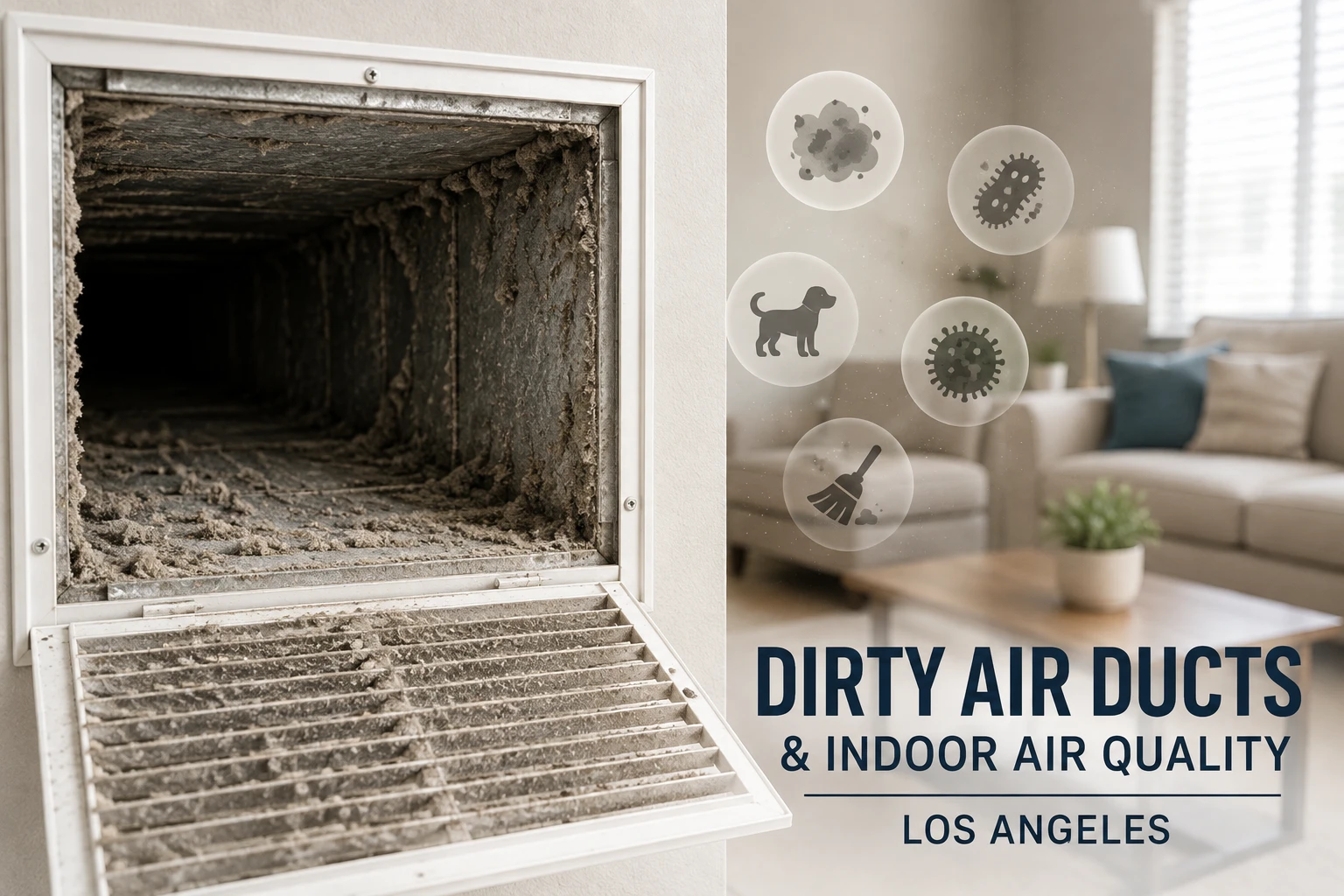
Every supply and return duct in your house is a long, dark, mostly still surface that air moves across constantly. Over years, that surface collects exactly what you'd expect: settled house dust, skin cells, pet dander, pollen that made it through the filter, fine construction debris, and — on the return side especially — whatever gets pulled in from an attic, crawlspace, or garage the ductwork passes through. In flex duct systems (the ribbed insulated tubing common in most LA attics), some of that material also includes tiny fibers shed from the duct's own interior liner as it ages.
None of that is unusual. Every forced-air home has some level of it. The question that actually matters isn't "is there dust in my ducts" — there is, in every home — it's whether what's built up is enough to measurably affect the air you breathe, and whether it points to a problem bigger than dust.
Why Los Angeles homes build up duct contamination faster than most
A few things about this region make ductwork here accumulate debris on a different timeline than a typical Midwest or East Coast home:
- Santa Ana wind events push large volumes of fine dust and pollen into the region several times a year, and homes with older or leaky duct systems pull a share of that directly into the supply air.
- Wildfire smoke season means ash and combustion particulate settle on every exterior surface, including attic ductwork, in years with significant fire activity. Homes near foothill and canyon areas see this most.
- Nearly year-round system operation. Unlike climates with a genuine off-season, LA systems run cooling for 7-8 months and see far less downtime overall — more total airflow hours means more particulate movement and settling.
- A lot of older housing stock. Many San Fernando Valley and LA homes still run original ductwork from the 1960s-80s, often uninsulated, unsealed, and running through attics that see 130°F+ summer temperatures — conditions that degrade duct liner and insulation over time.
- The ADU and remodel boom. Construction dust from an active renovation next door — or in your own home — is one of the most common single sources of a sudden, heavy duct contamination event.
None of this means LA homes are unusually unhealthy. It means the specific factors that drive duct buildup — dry, dusty air; heavy system runtime; older unsealed ductwork; occasional smoke events — are all more common here than in most of the country.
How dirty ducts actually affect indoor air quality — and where the marketing oversells it
This is the part most duct-cleaning advertising gets wrong in one direction or the other. Here's the accurate version.
What's true: every time your system runs, supply air passes over whatever is sitting inside the ductwork on its way to your rooms. If that's ordinary settled dust, the effect on your air is minor — it's already similar to what settles on every other surface in your home. If it's something more specific — active mold growth inside the ducts, heavy accumulation from a construction event, or debris from a rodent or insect infestation — the system is now actively redistributing that material into every room, every cycle, all day. That's a real and legitimate air quality issue.
What's oversold: the idea that typical dust buildup in ducts is, by itself, a health hazard that demands cleaning on a set schedule. The EPA's actual published position (not the version most duct-cleaning companies quote) is that there's no evidence connecting routine duct dust to specific health effects in most homes, and no research showing that periodic duct cleaning — absent an actual contamination problem — measurably improves health outcomes. The EPA's guidance is to clean ducts when there's evidence of a problem, not on a calendar.
In other words: dirty ducts can meaningfully affect your air quality — but "dirty" in the sense that matters means mold, pests, or heavy contamination, not the ordinary dust every duct system accumulates.
What duct cleaning can actually accomplish
- Removes an identified contamination source — visible mold, heavy dust from a renovation, or debris from a pest problem gets physically extracted rather than continuing to circulate.
- Eliminates a related odor. Musty smells that trace back to biological growth or trapped debris in the ducts usually resolve once the source is removed.
- Restores airflow in cases of severe blockage. This is uncommon, but a duct that's genuinely choked with debris (rare outside of long-neglected systems or post-construction homes) can see a real airflow improvement.
- Gives you a documented baseline. A camera inspection before and after tells you exactly what condition your ducts were in — useful information whether or not cleaning turns out to be necessary.
What duct cleaning can't accomplish
This is the section most duct-cleaning marketing skips, and it's the one that actually protects you as a homeowner.
- It doesn't fix a moisture problem. If mold is growing in your ducts, something is keeping that section damp — a condensate issue, a leak, or humidity intrusion. Clean the ducts without fixing the moisture source and the mold comes back.
- It doesn't seal leaks. Leaky return ducts pull unconditioned attic, crawlspace, or garage air directly into your supply air on every cycle — a bigger, ongoing contamination source than any amount of settled dust. Cleaning doesn't touch this; sealing does.
- It doesn't replace filtration. Whatever's making it past your filter today will keep making it past your filter tomorrow, cleaned ducts or not.
- It doesn't "sanitize" your whole home's air the way some fogging or ozone treatments are marketed to do. Ozone generators in particular are flagged by both the EPA and California Air Resources Board as producing a lung irritant at levels that can matter indoors — not a service we perform or recommend.
- It won't cure asthma or allergies if the trigger isn't actually in your ductwork. Outdoor pollen, a pet, humidity, or an unrelated source won't respond to duct work at all.
A reputable technician tells you which category you're in before selling you anything.
Signs it's actually time to call someone — not just clean, diagnose
These are the situations where duct contamination is genuinely worth addressing, based on evidence rather than a maintenance calendar:
- Visible mold growth at supply or return registers, or on the visible portion of the coil or plenum
- A musty or stale smell that gets noticeably stronger when the system is running
- Visible dust or debris blowing out of supply registers when the system starts
- Known rodent or insect activity in the attic or crawlspace where ductwork runs
- A recent renovation, construction project, or fire/smoke event that introduced heavy debris
- Allergy or respiratory symptoms that are noticeably worse indoors than outdoors, with no other obvious cause
- Ductwork that's original to a home 20+ years old and has never been inspected
- Visible physical duct damage — crushed flex duct, disconnected joints, or sagging insulation (also an airflow and efficiency issue; see our piece on why one room runs hotter than the rest of the house, since duct damage is a common cause)
If none of these apply and your system otherwise runs well, routine duct cleaning is optional, not urgent.
Duct cleaning vs. duct sealing vs. duct replacement vs. filtration — knowing which one you actually need
These get bundled together in a lot of marketing, but they solve different problems:
- Duct cleaning removes debris that has already accumulated inside otherwise sound ductwork. It's a one-time remediation, not an efficiency upgrade.
- Duct sealing (mastic sealant or an aeroseal-type process) closes the physical leaks in the ductwork itself. In older LA homes this is frequently the higher-impact fix — a leaky return can be pulling attic air, insulation fibers, and dust directly into your supply air on every single cycle, which no amount of duct cleaning will stop happening again.
- Duct replacement is warranted when ducts are physically damaged, undersized for the system, or deteriorated beyond effective repair — common in homes with original 1960s-80s ductwork or asbestos-era insulation wrap, which requires specialized handling rather than standard cleaning.
- Filtration upgrades (a higher MERV-rated filter, or supplemental purification) address what's continuously entering your air going forward, rather than what's already settled. During wildfire smoke events, the California Air Resources Board specifically recommends a MERV-13 filter if your system can handle the added static pressure — a change most homeowners can make in five minutes, with more sustained benefit than a duct cleaning.
Homes with a genuine indoor air quality problem often need a combination — most commonly sealing plus filtration, occasionally cleaning as well if there's an active contamination source. We diagnose which combination applies before quoting any of it.
What actually moves the needle on LA indoor air quality long-term
- Change your filter on schedule — monthly during heavy summer use is the single highest-impact, lowest-cost thing most homeowners can do.
- Seal known return leaks, especially in attic-run ductwork, so the system stops pulling in unconditioned air from spaces you don't live in.
- Keep up with annual maintenance so a coil, drain, or airflow problem gets caught before it becomes an air quality problem — see our spring AC tune-up checklist for what that actually covers.
- Address moisture at the source — a clear condensate drain and correctly sized system prevent the damp conditions mold needs to establish in the first place.
- Bump filtration during smoke events, not just after them, if you live somewhere that sees wildfire smoke impact most summers.
- Consider a ductless setup for problem rooms. A ductless mini-split sidesteps whole-house duct contamination entirely for the room it serves, since there's no shared ductwork to accumulate debris or leak.
For a broader look at filtration, purification, and ventilation options beyond ductwork itself, see our indoor air quality page.
How to choose a duct cleaning company you can actually trust
If cleaning does turn out to be the right call, the difference between a company that helps and one that just disturbs dust into your home comes down to a few things:
- NADCA-certified technicians following source-removal technique — negative pressure at the main trunk with agitation at every branch, not just a hose blowing air around.
- A camera inspection before and after, so you see documented evidence of what was actually in your ducts and what came out — not just a technician's word for it.
- No pressure toward "sanitizing" fog or chemical treatments unless there's an actual, identified biological contamination finding that warrants it.
- Transparent, itemized pricing. A flat "$99 whole-house" advertised special almost never covers what a full system actually needs — it's typically a lead-in price followed by an in-home upsell to the real cost.
Bottom line
Dirty ducts can genuinely affect your indoor air quality — but the version that matters is mold, pest contamination, or heavy debris, not the ordinary dust every duct system collects over time. If you're seeing one of the specific warning signs above, a professional inspection is worth it. If you're not, your money is usually better spent on a good filter, sealing known leaks, and staying current on maintenance. We'll tell you honestly which situation you're in before we recommend anything.
Duct Cleaning & Air Quality FAQs
Does the EPA recommend cleaning air ducts on a set schedule, like every few years?
Will duct cleaning cure my allergies or asthma symptoms?
Is duct cleaning worth doing if I don't notice any problems?
What's the difference between duct cleaning and duct sealing?
Can dirty ducts actually raise my energy bill?
Ready to get started?
Free in-home consultation with any new or replacement HVAC system, or any service / repair over $200. We answer the phone 24/7.