What Your HVAC Noises Are Trying to Tell You: A Homeowner's Complete Guide to Diagnosing Strange Sounds
Most homeowners live with a strange HVAC noise for months before calling anyone — it's easy to tune out, and it's rarely an emergency in the moment. The problem is that a noise is almost always the earliest, cheapest warning sign your system gives you. By the time it turns into a no-cool call in July, the $150 fix has usually become a $1,500 one.
Why sound is one of the best early-warning systems you have
An HVAC system that's running correctly has a consistent sound signature — the same soft whoosh of air, the same faint hum, the same brief click at startup, day after day. When that signature changes, it's because something inside the system changed: a part loosened, a component started failing, airflow got restricted, or refrigerant started leaking. The sound almost always shows up before the system stops working entirely, which makes it the cheapest possible moment to catch a problem — if you act on it instead of waiting it out.
Quick reference: what your HVAC noise probably means
Start here for a fast read, then jump to the section below for the full explanation of any sound that matches what you're hearing.
| Sound | Most likely cause | What to do |
|---|---|---|
| Loud banging or clanking | Loose or broken part inside blower or compressor | Call a technician |
| Rapid, repeated clicking | Failing relay, capacitor, or control board | Call a technician |
| Squealing or screeching | Belt wear or a failing motor bearing | Call a technician |
| Buzzing from outdoor unit | Failing capacitor, loose panel, or debris in the fan | Call a technician |
| Hissing near the coil or lines | Possible refrigerant leak | Call a technician |
| Hissing at a gas furnace, with a gas smell | Possible gas leak | Leave the house, call the gas utility |
| Whistling at vents | Restricted airflow — dirty filter or blocked vent | Check filter first, then call if it continues |
| Rattling | Loose panel, screw, or debris in the outdoor unit | Safe to check yourself first |
| Gurgling or bubbling | Refrigerant or condensate drain issue | Call a technician |
| Occasional popping or ticking from ducts | Metal ductwork expanding or contracting | Usually harmless |
| Loud rumbling or vibrating hum | Compressor wear or an unlevel outdoor unit | Call a technician soon |
| Metal-on-metal grinding | Imminent component failure | Shut off system, call immediately |
Sounds from your outdoor unit
The outdoor condenser unit houses the compressor and the outdoor fan, and most of the noises that indicate real trouble originate here.
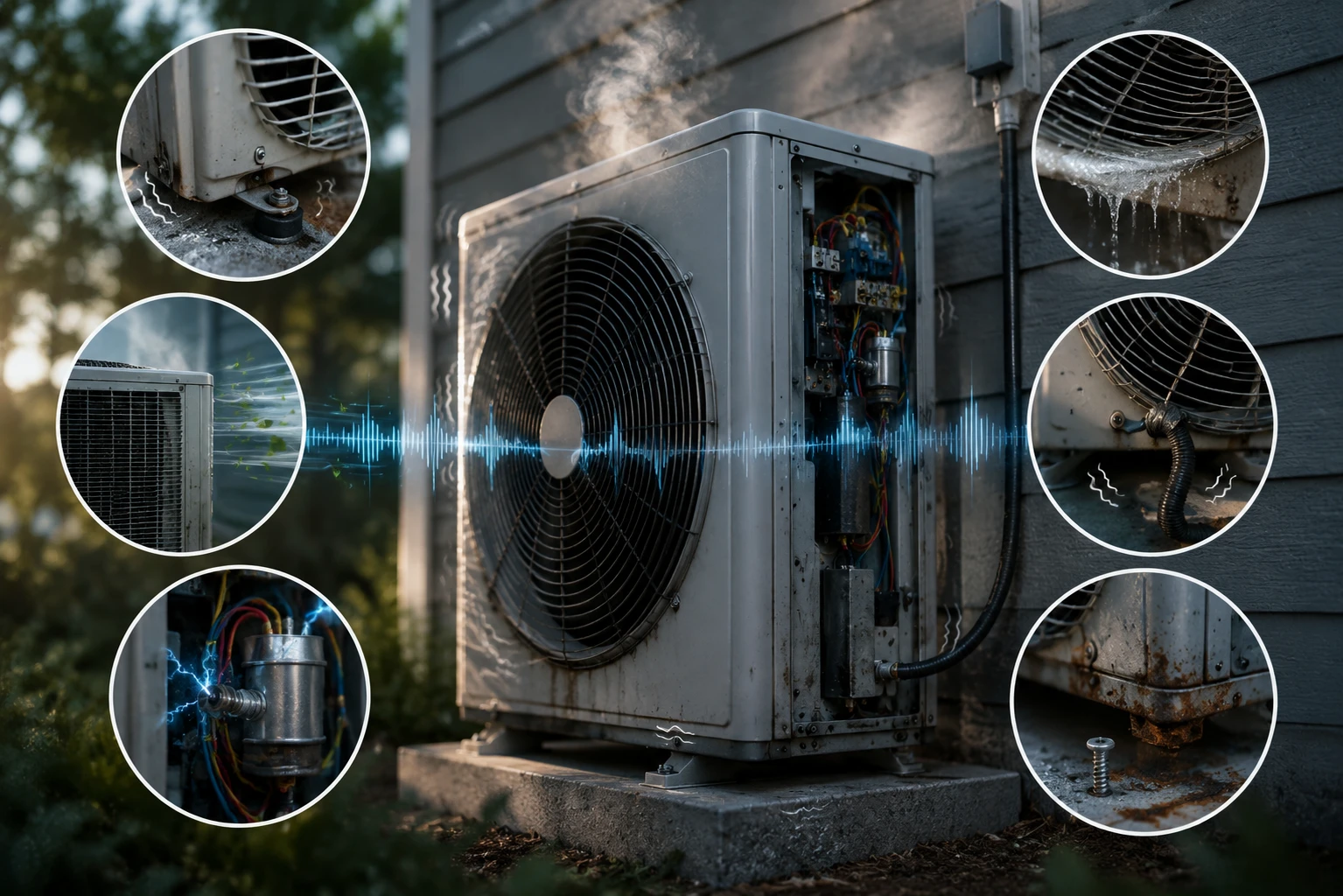
Buzzing or humming. A faint, steady hum during normal operation is nothing to worry about. A louder buzz — especially one that's new — often points to a failing run or start capacitor, a loose electrical connection inside the disconnect box, or debris caught in the fan blade. Capacitors are inexpensive to replace but fail more often in extreme heat, which makes this one of the most common LA summer service calls.
Clanking or banging. This usually means something has come loose inside the unit — a connecting rod, a mounting bolt, or in worse cases a piece of the compressor itself. It's not safe to keep running the system with this noise present.
Screeching or squealing. On older belt-driven blower systems, this is classic belt wear. On the more common direct-drive systems installed in most homes today, a similar sound usually means a motor bearing is failing — either on the outdoor fan motor or, if it's coming from indoors, the blower motor.
Loud rumbling or vibration. A deep, vibrating hum that's louder than the unit's normal operating sound is one of the more common signs of a compressor nearing failure. It can also mean the unit's pad has settled unevenly, or a fan blade has bent and is striking something on each rotation. Either way, it's worth a same-week look — the compressor is the single most expensive component in the system.
Sounds from your indoor unit
The air handler or furnace lives in a closet, attic, or garage in most LA homes, and its sounds are easier to miss simply because you're not standing next to it.
Clicking. A couple of clicks at startup and shutdown is completely normal — that's the relay or contactor engaging, or an igniter cycling on a gas furnace. Rapid, repeated clicking that doesn't resolve into the system actually starting is different: that's usually a failing capacitor, relay, or control board trying and failing to get the system going.
Whining. A high-pitched whine from a variable-speed blower motor at very low volume can be part of normal operation on some modern systems. A whine that's new, loud, or getting worse over time usually points to motor or bearing wear.
Popping. Occasional popping or ticking as the system starts or stops is usually just metal ductwork expanding and contracting with the temperature change — especially common in LA attics, where duct temperature can swing more than 80°F between a summer afternoon and an air-conditioned night. Generally harmless.
Gurgling or bubbling. This is worth taking seriously — it often means refrigerant moving through the lines abnormally (a sign of a leak or undercharge) or a condensate drain issue causing water to pool and gurgle instead of draining cleanly.
Hissing. Context matters enormously here, covered in its own section below.
Sounds from your ductwork and vents
Whistling. This is almost always airflow trying to squeeze through a restriction — a dirty filter, a mostly-closed vent, or ductwork that's undersized for the airflow being pushed through it. If you've been closing vents to try to save money, this is one of the direct symptoms; see our piece on why closing air vents doesn't save money for why that habit often causes exactly this problem.
Rattling. Usually a loose register cover, a screw that's worked its way out of a panel, or debris that's made its way into the outdoor unit's fan cage. Safe to check yourself — tighten visible screws, clear obvious debris — before assuming it's something bigger.
Booming or popping in the ducts. Same expansion-and-contraction cause as popping at the air handler, just heard further down the duct run. If it's loud enough to be startling rather than a soft tick, it's worth mentioning to a technician at your next visit, but it's rarely urgent on its own.
The sounds that mean stop and call immediately
A small number of sounds are genuine safety issues, not just mechanical ones, and deserve their own category:
- Hissing near a gas furnace combined with any smell of gas. This is a potential gas leak. Leave the house, don't operate any switches or your phone inside, and call your gas utility's emergency line from outside before calling us or anyone else.
- Metal-on-metal grinding or scraping. This means a moving part has lost its normal clearance and is actively damaging itself and likely surrounding components with every second the system runs. Shut it off.
- Any unusual noise paired with a burning smell. Shut off the system at the thermostat and, if you smell something electrical rather than just dusty, shut off the breaker too.
- A loud bang followed by the system no longer running correctly. Don't try to restart it repeatedly — that risks compounding whatever just failed.
Sounds that are actually normal (so you're not chasing ghosts)
It's just as useful to know what shouldn't worry you:
- A soft, continuous whoosh of air from supply registers while the system runs
- One or two clicks at the start and end of each cycle
- A faint, steady hum from the outdoor unit, audible only if you're standing near it
- Occasional, soft ticking or popping from ductwork as it warms or cools
- A brief whoosh or click when the system switches between heating and cooling modes
If what you're hearing matches this list, it's almost certainly not something to worry about.
What you can safely check yourself before calling
- Replace the air filter if it's been more than a month or two — this alone resolves a surprising share of whistling and airflow complaints
- Clear leaves, debris, or overgrown landscaping from around the outdoor unit
- Check that the noise correlates with a specific mode (only in heating, only in cooling) or a specific stage (only at startup, only while running) — that detail helps a technician diagnose faster
- Confirm the breaker hasn't partially tripped, which can cause a motor to hum without starting properly
Beyond that — anything involving gas, refrigerant, grinding, or a smell — it's a call, not a DIY project. Staying current on annual maintenance also catches a lot of these failure points (weak capacitors, loose electrical connections, worn contactors) before they turn into a noise at all.
Why ignoring the noise usually costs more later
A weak capacitor making an occasional buzz is a $150-$350 fix today. Left alone, it eventually fails outright — often on the hottest day of the year, often taking a compressor down with it, and now you're looking at a repair bill in the thousands instead of hundreds. Nearly every noise-driven failure we see follows the same pattern: cheap and simple if caught early, expensive and urgent if it isn't. Treating a new or changed sound as information worth acting on, rather than background noise to tune out, is the single easiest way to avoid an emergency AC repair or furnace repair call at the worst possible time.
Bottom line
Your system's sound is telling you something almost every time it changes. Most of what you'll hear is either completely normal or a cheap, early fix if you act on it — the expensive outcomes almost always trace back to a noise that got ignored for months, not one that came out of nowhere. If something doesn't match the "normal" list above, it's worth a call.
HVAC Noises FAQs
Is it normal for my AC or heater to make some noise?
What does it mean if my AC is making a hissing sound?
Why does my furnace or AC click a few times when it turns on?
What noise means I should turn my system off immediately?
Can a loud noise mean my compressor is failing?
How much does it cost to fix a noisy HVAC system?
Ready to get started?
Free in-home consultation with any new or replacement HVAC system, or any service / repair over $200. We answer the phone 24/7.