Questions Most Homeowners Forget to Ask Before Installing a New HVAC System
Most homeowners walk into an HVAC estimate asking one question: how much, and how big. Those are the two questions every salesperson is prepared for. The questions that actually determine whether you're happy with the system in year five — not just at install — are the ones almost nobody asks. Here they are, from someone who's been on the other side of that contract for twenty years.
The estimate you get is only as good as the questions you ask
Replacing an HVAC system is one of the largest purchases a homeowner makes, and one of the least understood. Most people shop it the way they'd shop a refrigerator — compare a couple of quotes, check the brand name, ask about the price and the SEER number, and go with whoever seems trustworthy. That approach gets you a system. It doesn't get you the right system, installed correctly, sized for your actual house, and backed by a warranty that will hold up when you need it.
Twenty years of installs, callbacks, and second opinions on other contractors' work has taught me that almost every expensive HVAC regret traces back to a question nobody asked before the contract was signed. None of what follows is exotic. It's the stuff a careful contractor should volunteer — and the stuff a corner-cutting one is happy to skip if you don't bring it up first.
"What size do I need?" is the wrong question — ask for a load calculation instead
Almost every homeowner asks how many tons they need. Almost every quick answer is wrong, because tonnage by itself means nothing without knowing the house it's cooling. The right question is: "Can I see the Manual J load calculation for my home?"
A Manual J calculation is an industry-standard method that accounts for your home's square footage, insulation levels, window count and orientation, ceiling height, air leakage, and local climate data to determine the actual heating and cooling load — measured in BTUs, not just tons. Skip it, and an installer is either guessing based on square footage (a rough rule of thumb that ignores everything that makes your house different from the one next door) or simply matching whatever size is currently installed, which just carries forward whatever sizing mistake was made the first time.
Oversizing is the far more common mistake in Los Angeles, and it's expensive in ways that don't show up on the price tag. An oversized system cools the air fast enough to satisfy the thermostat before it's had time to properly dehumidify the space, so you get short, hard cycles, a house that feels clammy even at the "right" temperature, and a compressor that wears out faster from constant starting and stopping. Undersizing shows up differently — a system that runs nearly continuously on hot days and never quite catches up. Both are avoidable with a proper calculation that takes fifteen minutes and should be included in any serious estimate at no extra charge.
Is my existing ductwork actually right for this new system?
New equipment gets attached to old ductwork constantly, and it's one of the most common reasons a brand-new, correctly sized system still delivers uneven comfort. Ductwork sized and designed for one piece of equipment doesn't automatically work for another — a higher-efficiency variable-speed system in particular needs duct sizing and airflow that many older duct systems in LA homes, some installed decades ago for a very different unit, simply can't deliver.
Ask your contractor directly: "Are you evaluating my ductwork, or just reconnecting to it?" A thorough contractor checks static pressure, looks for undersized trunk lines, crushed or disconnected flex duct in the attic, and leakage at the joints — all of which quietly rob a new system of the performance you're paying for. If nobody mentions ductwork at all during the estimate, that's the gap to ask about before you sign anything.
What refrigerant does this system use — and is it already on its way out?
This is a question almost nobody thinks to ask, and it has real financial consequences. Federal regulations have phased R-410A out of new residential equipment manufactured from 2025 onward, in favor of lower global-warming-potential refrigerants like R-454B. Some contractors are still selling through pre-2025 R-410A inventory at a discount, which can look like a good deal upfront but leaves you owning a system built around a refrigerant that will become progressively harder and more expensive to service as the industry finishes the transition.
Ask plainly which refrigerant the proposed system uses, and if it's not current-generation, ask why. A lower price on outgoing-refrigerant equipment isn't automatically a bad choice, but it should be a decision you make knowingly — not one that gets made for you because nobody brought it up.
Single-stage, two-stage, or variable-speed — what does that actually change day to day?
Contractors will often present this as a budget decision, and it is one, but it's also a comfort decision that homeowners rarely get walked through in plain terms.
- Single-stage systems run at full capacity or not at all. Least expensive, most durable in its simplicity, but produces the largest temperature swings between cycles and runs the hardest on moderate days when full output isn't actually needed.
- Two-stage systems can run at a lower capacity most of the time, reserving full output for the hottest afternoons. This means longer, gentler cycles, better humidity control, and noticeably steadier comfort for a moderate cost increase over single-stage.
- Variable-speed systems adjust output continuously rather than stepping between fixed levels, running long and quiet at low speed the majority of the time. This is where you get the best comfort, the best dehumidification, and typically the best real-world efficiency — at the highest equipment cost of the three.
The right answer depends on your budget and how much you value steady comfort over the lowest sticker price — but you should be told this tradeoff exists, in these terms, before you're handed a single number to sign off on.
Will my electrical panel actually handle this — especially for a heat pump?
This question gets skipped constantly, and it turns into an expensive surprise mid-installation more often than any other item on this list. Heat pumps generally draw more amperage than a comparable gas furnace and AC pairing did, and a lot of older LA homes are still running 100-amp electrical panels that are already close to capacity once you account for an EV charger, a pool pump, or a newer kitchen.
Ask before you select equipment, not after: "Does my panel have room for this, and if not, what does an upgrade cost?" A contractor who can answer this confidently at the estimate stage — ideally having actually looked at your panel — is going to save you from a change order discovered halfway through install day.
Who's pulling the permit, and will this actually pass inspection?
Every HVAC replacement in Los Angeles requires a permit through LADBS (or the applicable local building department), and it's not optional paperwork — it's the mechanism that confirms the work was actually inspected against code, which matters enormously if you ever sell the house or file an insurance claim involving the system. Unpermitted HVAC work is a real and recurring problem in resale transactions, where it surfaces during a buyer's inspection and becomes a negotiating chip against the seller, sometimes years after the original homeowner has forgotten the system was never permitted.
Ask directly: "Is a permit included in this quote, and who's responsible for scheduling the inspection?" A legitimate contractor pulls it as a matter of course and treats the cost as part of the job, not an upcharge you have to request.
What's actually covered by the warranty — and who pays for labor?
"Ten-year warranty" sounds reassuring and tells you almost nothing on its own. Three follow-up questions matter far more than the number of years printed on the brochure:
- Is it registered in my name, and within what window? Most manufacturers require online registration within 60-90 days of installation. Miss that window and the warranty often defaults to a much shorter base term — sometimes just five years instead of ten — without any notice until you file a claim and get denied.
- Does it cover labor, or only parts? Manufacturer warranties typically cover replacement parts but not the labor to diagnose and install them, which can be the majority of a repair bill. Some installers offer a separate labor warranty of their own — ask if one is included and for how long.
- Who's actually on the hook if something goes wrong? If your installer goes out of business, a manufacturer parts warranty can still be honored by any licensed contractor, but a labor warranty tied to the original installer disappears with the company. Ask how long that company has been operating, not just what the paperwork promises.
How loud will this be, and where is it actually going?
Outdoor condenser placement gets treated as an afterthought far too often, and it has real consequences in LA's tighter side-yard lot layouts. Ask for the unit's rated sound level in decibels and where exactly it's being placed relative to your bedroom windows, your neighbor's bedroom windows, and any local noise ordinance your city or HOA enforces. Variable-speed compressors run meaningfully quieter than single-stage ones at partial load, which matters if the unit sits close to where people sleep. This is also worth asking about specifically if you're near the coast — see our guide on how coastal air affects HVAC equipment lifespan for the corrosion side of condenser placement too.
What's the manufacturer's rated efficiency versus what I'll actually get installed?
The SEER2 or HSPF2 number on the spec sheet describes the equipment's efficiency under laboratory test conditions with correctly matched components and proper installation. It is not a guarantee of what you'll experience in your house. Mismatched indoor and outdoor units, undersized ductwork, low refrigerant charge from a rushed installation, or poor airflow can all quietly shave meaningful efficiency off that rated number without ever showing up as an obvious problem — the system still runs, it just costs more to run than it should.
Ask whether the indoor coil and outdoor condenser are AHRI-matched (a certified combination tested together to actually achieve the rated efficiency) and whether the installer verifies refrigerant charge and airflow with actual measurements at commissioning, not just a visual check that the system turns on.
Should I be zoning this system instead of replacing like-for-like?
A full system replacement is the single best time to reconsider whether one thermostat controlling the whole house still makes sense — because retrofitting zoning later means opening up ductwork you just paid to close. If you've got rooms that run hotter or colder than the rest of the house, or a two-story layout fighting itself year-round, ask whether a zoning system or a supplemental ductless mini-split for a problem room makes more sense than another single-zone system. It's a bigger conversation than most estimates make room for, but replacement day is the cheapest time to have it.
What does the first year of ownership actually look like?
Ask what's included after the crew leaves: is there a startup/commissioning visit, a follow-up check a few months in, and what maintenance schedule does the manufacturer's warranty actually require to stay valid? Many warranties are contingent on documented annual maintenance — skip it, and you can lose coverage without realizing the requirement existed. Get this in writing rather than taking a verbal assurance, and ask what a tune-up costs going forward so there's no surprise later.
A practical question checklist to bring to every estimate
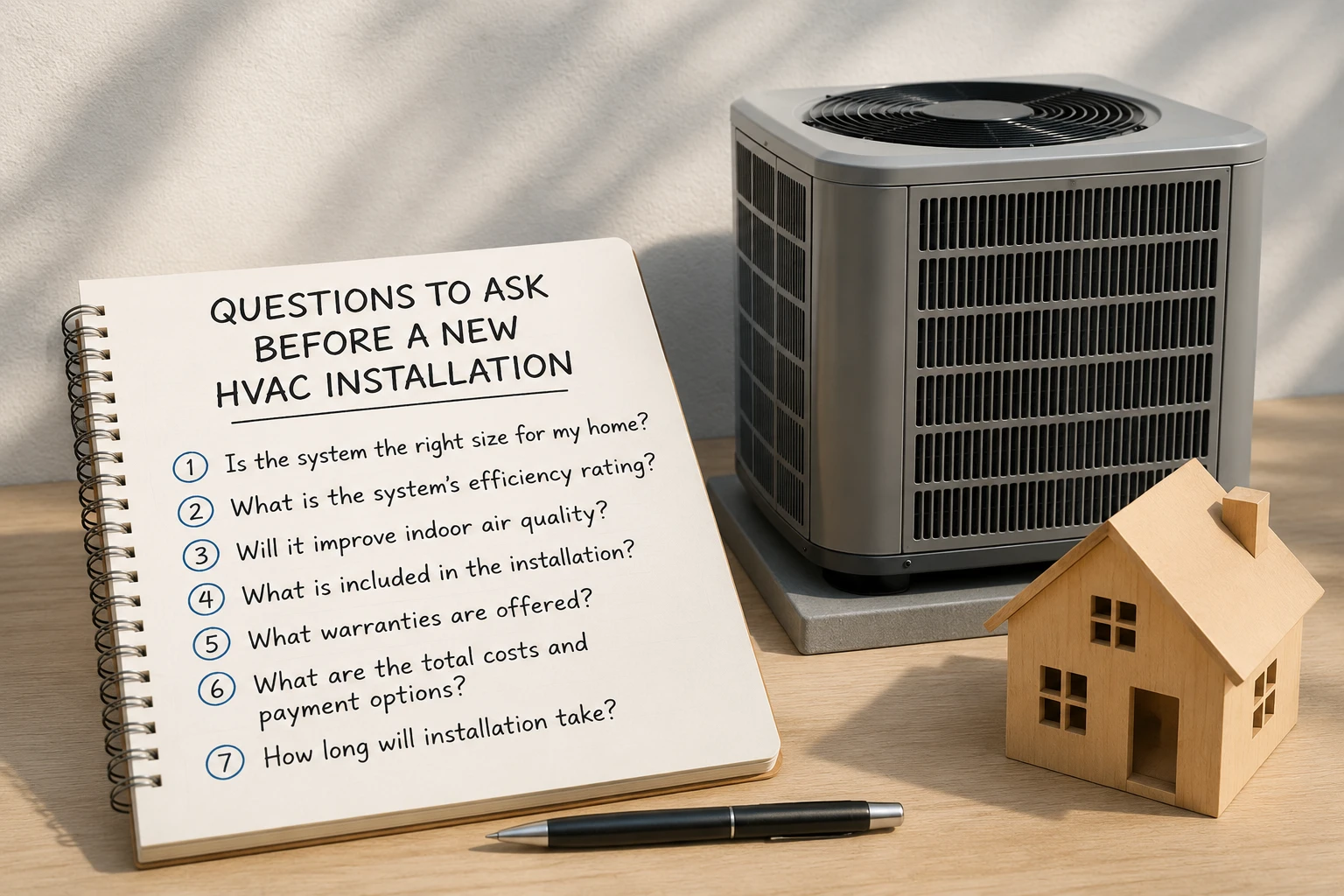
- Can I see the Manual J load calculation for my home, not just a tonnage recommendation?
- Are you evaluating my existing ductwork, or just reconnecting new equipment to it?
- What refrigerant does this system use, and is it current-generation?
- What's the real-world difference between the staging options you're quoting me?
- Does my electrical panel have capacity for this system, especially if it's a heat pump?
- Is a permit included, and who schedules the inspection?
- What exactly does the warranty cover — parts, labor, or both — and what do I need to do to keep it valid?
- What's the rated sound level, and where is the outdoor unit going?
- Are the indoor and outdoor units AHRI-matched, and will you verify charge and airflow at commissioning?
- Should I be zoning this instead of replacing like-for-like?
- What's included in the first year after installation?
Bottom line
None of these questions are designed to make an HVAC purchase harder than it needs to be — they're designed to make sure the number on your estimate reflects a system that's actually sized, matched, installed, permitted, and warrantied the way it should be. A contractor who welcomes every one of these questions and answers them plainly is telling you something important about the installation itself. One who gets impatient with them is telling you something too.
New HVAC Installation FAQs
Do I really need a load calculation, or is matching my old system's size fine?
What's the difference between single-stage, two-stage, and variable-speed systems?
Should I ask about my electrical panel before choosing a heat pump?
Why does the refrigerant type matter for a system I'm installing today?
What warranty questions actually matter, beyond how many years it covers?
Ready to get started?
Free in-home consultation with any new or replacement HVAC system, or any service / repair over $200. We answer the phone 24/7.