
Can Landscaping Improve Your Air Conditioner's Efficiency? The Surprising Truth Every Homeowner Should Know
Shade genuinely helps your AC run less. Planting shrubs right up against the outdoor unit to give it shade genuinely hurts it. Both of those things are true at once, which is exactly why "just plant something near your AC" is bad advice and "landscape strategically around your house" is good advice — they're not the same suggestion.
Two different questions get bundled into one
"Can landscaping help my AC" is really two separate questions with two different answers: does shading your house reduce how much cooling it needs, and does shading your outdoor unit make that unit run more efficiently? The first answer is a solid yes, well-documented in building science. The second answer is a much smaller, more conditional yes — and it's the one homeowners get wrong most often, usually by planting something too close to the condenser in the name of "helping" it.
Shading your house: where the real savings come from
Your home's cooling load is driven substantially by solar heat gain — sunlight hitting windows and walls and converting to heat inside. In Los Angeles, west-facing glass is the single biggest contributor during summer, because the afternoon sun hits it at a low, direct angle for hours right as outdoor temperatures peak. Reduce that heat gain and your AC simply has less work to do, which shows up directly as reduced runtime and a lower bill.
The U.S. Department of Energy's Energy Saver guidance is that well-placed, mature shade trees can meaningfully cut a home's air conditioning costs — the honest caveat being mature. A newly planted tree provides almost no shade for its first several years. The size and position of the canopy over your west and south-facing windows is what matters, not the number of trees in the yard.
Shading your condenser: a real but much smaller effect
An air conditioner's outdoor unit works by rejecting heat from inside your home into the outdoor air — and like most mechanical processes, it does that job somewhat more efficiently when the air it's pulling in is cooler. Evapotranspiration from nearby trees and plants (the cooling effect of plants releasing moisture) can measurably lower the air temperature in the immediate area compared to open pavement, and shading the unit itself from direct sun keeps its internal components a little cooler during peak afternoon heat.
This effect is genuine, but it's secondary — a few percent of efficiency at most, not the double-digit swing that comes from shading the house itself. Treat it as a nice-to-have that follows naturally from good landscape placement, not a project to pursue on its own.
Why shading the condenser has to be done carefully
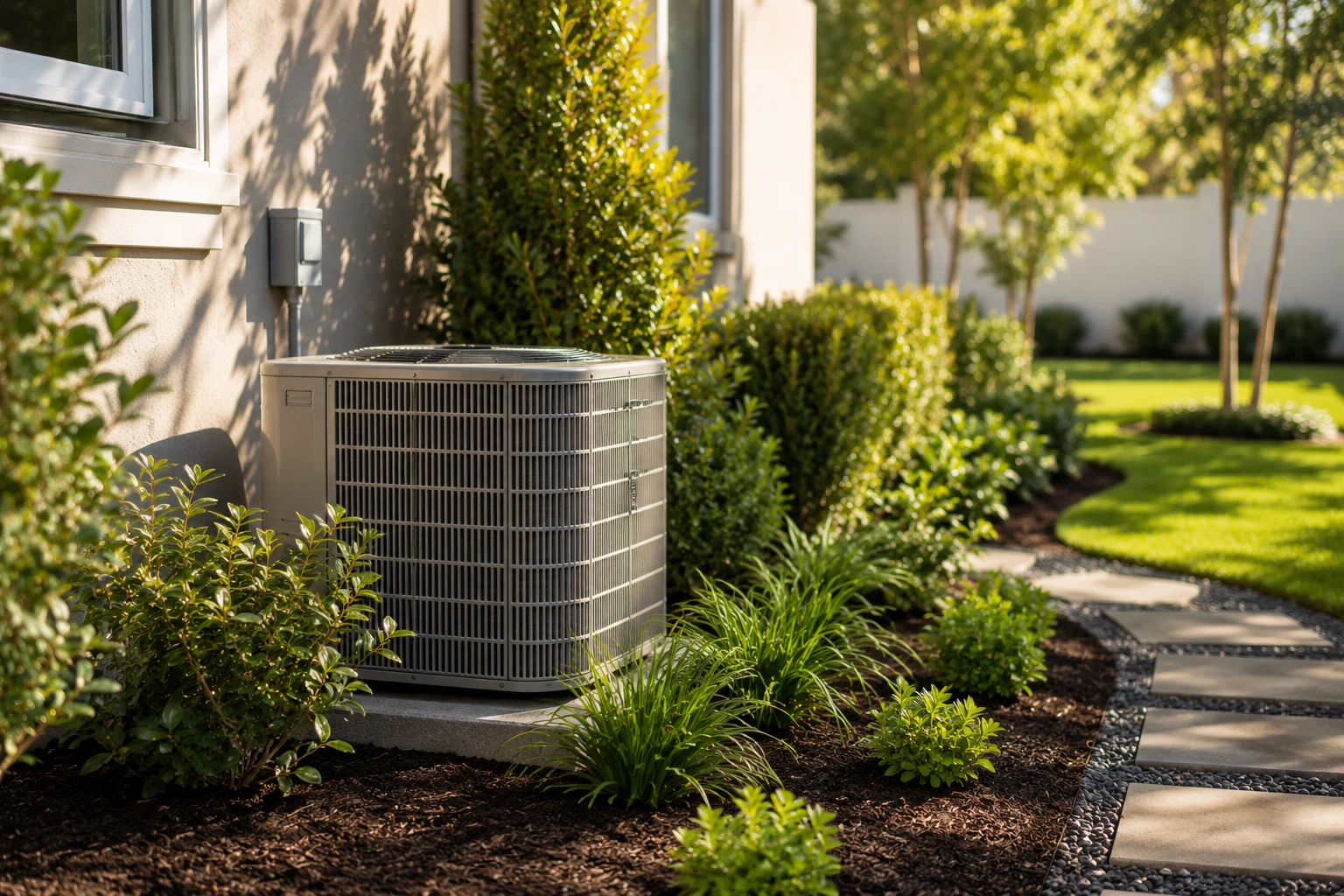
This is the part that trips people up. A condenser needs unobstructed airflow on all sides to pull in outdoor air and reject heat effectively — restrict that airflow and the unit's head pressure rises, efficiency drops, and the compressor works harder and wears faster. Planting shrubs or hedges close enough to "shade" the unit almost always restricts that airflow more than the shade helps, which nets out worse for efficiency than doing nothing at all.
There's also a maintenance tradeoff worth being upfront about: trees and shrubs near a condenser mean more leaf litter, seed pods, and pollen landing in the coil fins, which means more frequent cleaning to keep airflow where it needs to be. None of this means don't landscape near your unit — it means landscape around it with clearance in mind, not against it.
What actually works, in priority order
- Shade west-facing windows first. This is the single highest-impact placement in an LA climate, since afternoon west sun drives the largest share of summer cooling load.
- South-facing windows second. A deciduous tree here blocks high summer sun while letting lower winter sun through once the leaves drop — useful in a climate that still has a real, if mild, heating season.
- Awnings, solar screens, or a vine-covered trellis for faster results. A shade tree takes five-plus years to provide meaningful canopy. An awning or trellis over the same window provides a comparable shading benefit within a season or two, and works well as a bridge while a tree matures — or as the whole solution if you don't want to commit to a tree.
- Light-colored, reflective hardscaping near windows. Dark pavement and dark mulch absorb and re-radiate heat toward nearby walls and glass; lighter surfaces reduce that secondary heat load.
- The condenser, last and with clearance in mind. If a tree's natural canopy happens to shade the unit from a reasonable distance, that's a bonus. Don't plant specifically to shade it at the cost of airflow clearance.
A practical clearance guide
As a general rule, keep plantings at least 2-3 feet away from the outdoor unit on all sides, and leave roughly 5 feet of clearance above for any tree canopy — though it's worth checking your specific unit's manufacturer clearance spec, since requirements vary and the service-access side (where a technician needs to open panels) often needs more room than the others. For species selection, a local arborist or landscape professional can steer you toward shade trees that perform well in LA's climate with reasonable water needs — that's a horticultural question outside our expertise, but the placement and clearance guidance above applies regardless of which tree you choose.
Where landscaping can't help
Shade reduces load; it doesn't fix a system that's already struggling for other reasons. If your AC is undersized for the home, low on refrigerant, running with a dirty coil, or losing conditioned air through leaky ductwork, better landscaping won't meaningfully change your comfort or your bill — the underlying problem is still there, just working slightly less hard. A tune-up and an honest look at whether your equipment is correctly sized (see our SEER efficiency guide if you're also considering a replacement) tell you whether landscaping is complementing a healthy system or just putting a nicer face on a struggling one.
It's also worth pairing with the other genuinely effective, low-cost comfort strategy we've covered — see how ceiling fans and HVAC work better together for the indoor half of the same idea: reduce the load your AC has to fight, rather than just asking it to run harder.
Bottom line
Landscaping can genuinely lower your cooling costs — through shading the house, not the unit — but the savings come from where the sun hits your walls and windows, and they take time to materialize as trees mature. Shading the condenser itself provides a real but modest bonus, and only if it doesn't come at the cost of airflow clearance. Get the priorities right — windows before condenser, clearance before shade — and it's one of the few home improvements that pays you back every summer for decades. Get them backwards and you can genuinely make your system work harder, not easier, right at the unit that matters most.
Landscaping & AC Efficiency FAQs
Does shading my AC unit actually make it more efficient?
How close can I plant something to my outdoor AC unit?
How much can shade trees actually reduce my cooling bill?
What gives faster results than waiting for a tree to grow?
Can landscaping replace regular AC maintenance?
Ready to get started?
Free in-home consultation with any new or replacement HVAC system, or any service / repair over $200. We answer the phone 24/7.